Focus on Kubora
Why the rising tensions around Iran are not the real danger, and what the world is failing to see
One evening, a young analyst sat alone in front of multiple glowing screens, watching live updates from the Middle East. Missiles had not yet been launched, but the tension was already thick enough to feel. News anchors spoke with urgency, using words like “escalation,” “retaliation,” and “nuclear threat” in endless cycles, what disturbed him most was not what he was seeing, but it was what he realized.
Hours earlier, he had been in a simple disagreement with a colleague, nothing global, nothing violent, just words. But he remembered how quickly the conversation had shifted, how a small misunderstanding turned into defensiveness, how pride refused to step back, and how the desire to be right quietly overpowered the desire for truth. At this level there is no weapons, no armies and yet something inside him had already chosen conflict.
As he stared at the map highlighting potential war zones, a question formed in his mind uncomfortable, but impossible to ignore; “Is this how it starts?” Not with missiles… but with thoughts, not with nations… but with individuals, and not with war rooms… but within the human heart. In that moment, the distance between a personal argument and a global conflict no longer felt as wide as it once seemed, and a deeper realization emerged; What if the same force driving nations toward war is the one quietly operating within us every day?

Introduction: A World holding its breath
As global tensions rise around Iran fueled by geopolitical rivalry, nuclear fears, and fragile alliances, the world once again finds itself standing on the edge of uncertainty. News headlines speak of military readiness, economic disruption, and the looming possibility of large-scale conflict. But beneath the noise of politics and media analysis lies a deeper, more unsettling question; What if war is not the real problem?
What if what we are witnessing is not the cause but the symptom of something far more dangerous, more ancient, and more pervasive? This article introduces a concept rarely explored in global discourse: kubora means corruption.
focus on kubora: What is Kubora?
A simple and deeper definition of corruption
In many contexts, corruption is understood as bribery, abuse of power, or moral failure. But kubora goes far beyond these surface-level definitions. By a simplified definition, Kubora is the decay of original design. In other words, it is what happens when something created with purpose, order, and truth begins to deviate from its intended nature, it is not just wrongdoing but it is misalignment with truth at the deepest level of existence. This means that Kubora is not only political, or economic, but It is fundamentally spiritual, internal, and systemic. And when kubora reaches maturity, it does not remain hidden, it manifests, and War is one of its final expressions.

The three levels of Kubora
“From Invisible to Catastrophic”
To understand why wars continue across generations, we must trace Kubora through its progression. It develops in three distinct but connected levels:
- Spiritual Kubora
The root level
This is where corruption begins, in the separation from truth. At this level; identity is lost or distorted, truth is replaced with illusion, and purpose is abandoned or redefined. This is not visible to the eye, but it is the foundation of all visible crises. This means that, before any nation goes to war, something has already gone wrong within the human spirit, the seat of identity and alignment.

- Soulical Kubora
The internal system
Once truth is distorted, the mind and emotions begin to reorganize around that distortion. At this level; fear becomes a decision-making force, pride justifies domination, hatred is normalized, and evil is reframed as “necessary”. Here, individuals and leaders alike begin to agree with corruption internally, creating belief systems that can support conflict. This is where narratives are built, enemies are defined, and violence becomes acceptable.

- Physical Kubora
The visible manifestation
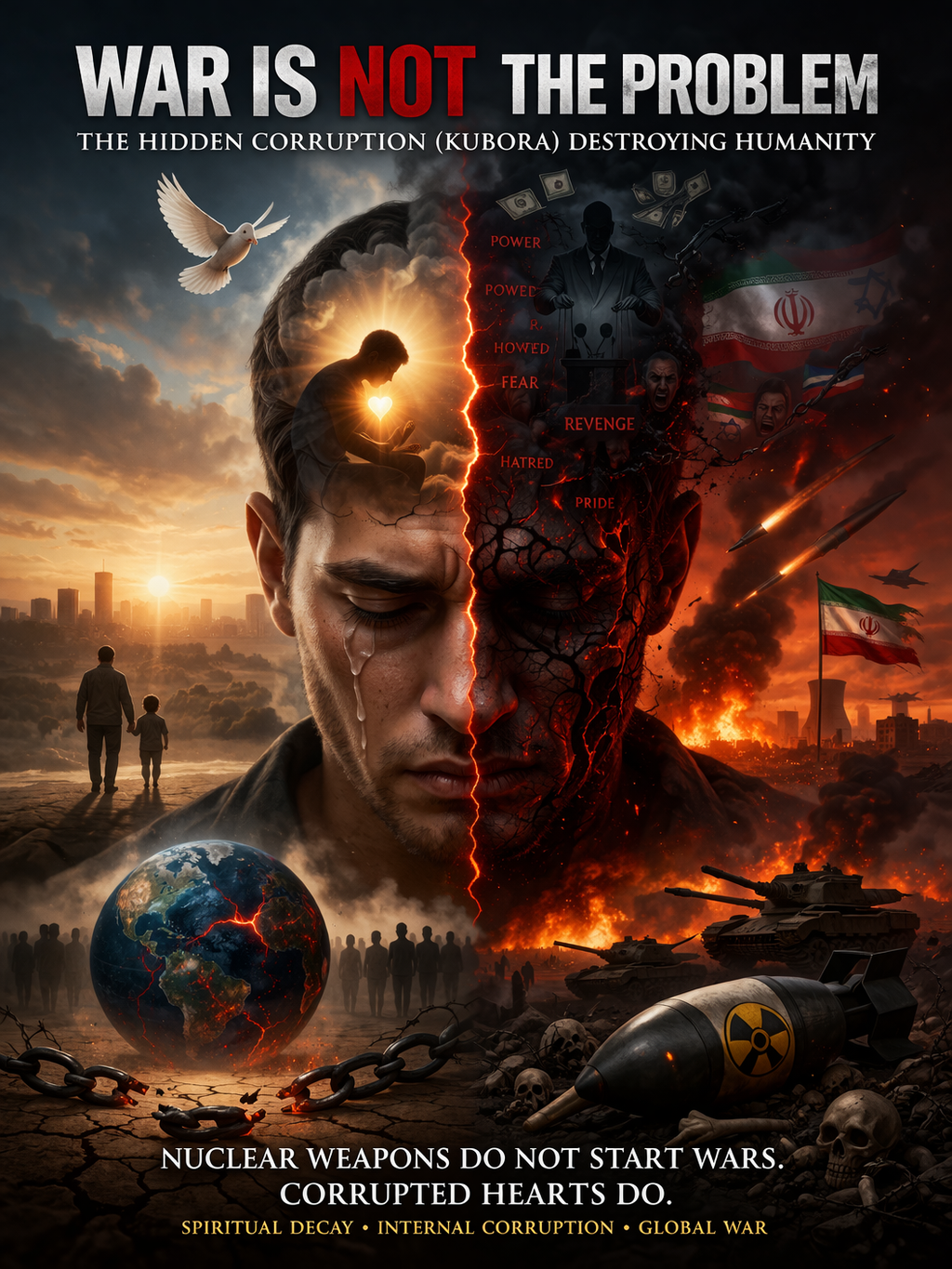
This is the stage the world recognizes, that manifested by war, weapons, destruction, economic manipulation, and loss of human life. By this point, kubora has fully matured. What began as a misalignment with truth has now become a global crisis. And yet, most solutions are focused only at this level, treating symptoms, not causes.
Iran is not the battlefield, but the human heart is.
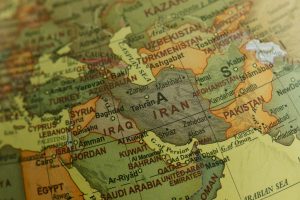
The current tensions surrounding Iran are often framed as political, ideological, or strategic. But this perspective is incomplete, because the Iran is not the origin of the problem, nor is any single nation. “The real battlefield is the human heart.”
What we are witnessing is a global reflection of internal corruption that exists across nations, cultures, and systems. The same forces that lead to international conflict are present in everyday human interactions; like the desire to control, the fear of losing power, the inability to reconcile truth, the justification of harm for perceived security. When these forces scale from individuals to institutions, the result is inevitable.
Why humanity cannot solve what it does not understand
Despite advancements in diplomacy, technology, and intelligence, humanity continues to repeat cycles of conflict. Why? Because most solutions address behavior, not being. For example, peace treaties address actions, not internal alignment, policies regulate systems, but not the human condition, and negotiations manage outcomes, but not origins. This means If kubora remains untouched at its root, every solution becomes temporary, and peace, in this context, is often just a pause between wars.

The uncomfortable truth is “war begins long before weapons”
One of the most dangerous misconceptions is that war starts with military action. But in reality; a war begins with a thought that is never corrected, it grows through beliefs that are never challenged, it spreads through systems that normalize distortion, By the time weapons are deployed, the war has already been won or lost within the human mind and spirit.

A call to the world is “confronting Kubora within”
If the world is to break free from endless cycles of conflict, it must confront a difficult but necessary truth which is “the greatest threat to humanity is not external, it is internal.” But this requires a shift or repent, here repent means the change of way of thinking. At this level the world need to shift from blaming nations to examining human nature, from managing crises to restoring truth, and from external control to internal transformation. The world does not simply need better strategies. It needs restored humans, individuals aligned with truth at their core.
Conclusion
“The future of humanity depends on this”
The rising tensions around Iran are not just a geopolitical issue, they are a warning signal. A signal that kubora is not only present, but advancing. If left unaddressed, it will continue to manifest again and again in different forms, in different regions, under different names. But the pattern will remain the same.
“The next global conflict will not begin with missiles, but It will begin with a thought that no one corrected”.

📝 INCAMAKE
Umunsi umwe nimugoroba, umusore wari wicaye imbere ya mudasobwa akurikirana amakuru y’intambara ishobora kubaho mu Burasirazuba bwo Hagati, cyane cyane ibijyanye na Iran. Nta misile yari yaraswa, ariko ubwoba n’impungenge byari byuzuye mu makuru. Gusa icyamukoze ku mutima cyane si ibyo yabonaga kuri televiziyo, ahubwo ni ibyo yibutse byabaye kuri uwo munsi.
Yari yagiranye impaka n’umugenzi we ku kintu cyoroheje, ariko mu kanya gato, ibiganiro bihinduka intambara y’amagambo. Ubwibone burazamuka, kumva ushaka gutsinda kurusha gushaka ukuri bifata umwanya, amahoro arabura. Nta ntwaro zari zihari, Nta ngabo zari zihari.
Ariko intambara yari yatangiye imbere muri we. Aho ni ho yibajije ati: “Ese intambara ni uku itangirira?”
Iyi nyandiko igaragaza ko intambara atari yo kibazo nyamukuru, ahubwo ari ingaruka z’ikibazo cyimbitse cyitwa kubora.
Kubora ni ukwangirika kw’umwimerere w’umuntu cyangwa ikintu, aho ava ku kuri n’intego ye ya mbere. Bitangirira imbere mu muntu, mu mwuka we, bigakomeza mu bitekerezo n’amarangamutima, hanyuma bikagaragarira hanze mu bikorwa nk’intambara n’isenyuka ry’imibereho. Iyi nyandiko isobanura ibyiciro bitatu bya kubora aribyo Kubora mu mwuka: gutandukana n’ukuri n’umwirondoro nyakuri, Kubora mu mitekerereze: ubwoba, ubwibone n’urwango bifata ubuyobozi, ndetse no Kubora kugaragara: intambara, gusenya n’imiyoborere mibi. Ubutumwa bukomeye ni ubu: ikibuga cy’intambara si ibihugu, ahubwo ni umutima w’umuntu, ni uko rero iyo kubora kutavuwe mu mizi, amahoro aba ari igihe gito hagati y’intambara ebyiri.
Umwanzuro
Nitutavura kubora imbere muri twe, tuzakomeza kurwana hanze, mu bihugu, mu miryango, no mu bisekuru byahazaza cyangwa ibiragano biri imbere.